Who is this debt collector?
You got a debt collection letter or call. Within five days, a real collector must send a written notice showing the end date of your 30 days to dispute. Type the name below to check who it is and write back.

You have a collector's letter in your state, and the end date printed on it is your last day to dispute in writing. A consumer lawyer can talk through this letter with you before that date passes. Call our debt help line during business hours, and you decide whether your details go further.
Call (844) 393-5856- You call during business hours and say which debt it is.
- You answer a few questions about the debt and any court date.
- You decide whether a consumer lawyer sees your details.
Calls go to our debt help line during business hours. The call costs you nothing, and you give up nothing by calling. Debt Collector Lookup matches people with consumer lawyers; we are not a law firm or a debt collector.
Is this collector real or a scam?
A real collector tells you its name, street address, and phone number. It also tells you about the debt in writing. A scammer avoids those details and pushes you to pay today.
Fake callers copy the names of real companies. So the name alone proves nothing. Hang up and call back on a number from the company's own website.
Our phone number lookup lists each tracked collector's published numbers. A threat to arrest you is a sign of fraud or unlawful collection.
Check a caller against our phone number lookup, or read the FTC warning on fake collectors.
Who are they collecting for?
Most collection letters name two companies. One is the collector writing to you. The other is the original creditor, the bank, hospital, or phone company you first owed.
Some collectors are debt buyers. They bought your account and now collect it as the owner. Other collectors are agencies that keep a cut of what they get.
Some collectors are law firms that sue people over debts. Each company page tells you which kind it is.
Do you really owe it?
The debt is not always yours. Collectors buy accounts in big batches, and the amount or the name can be wrong. The law lets you check before you pay anything.
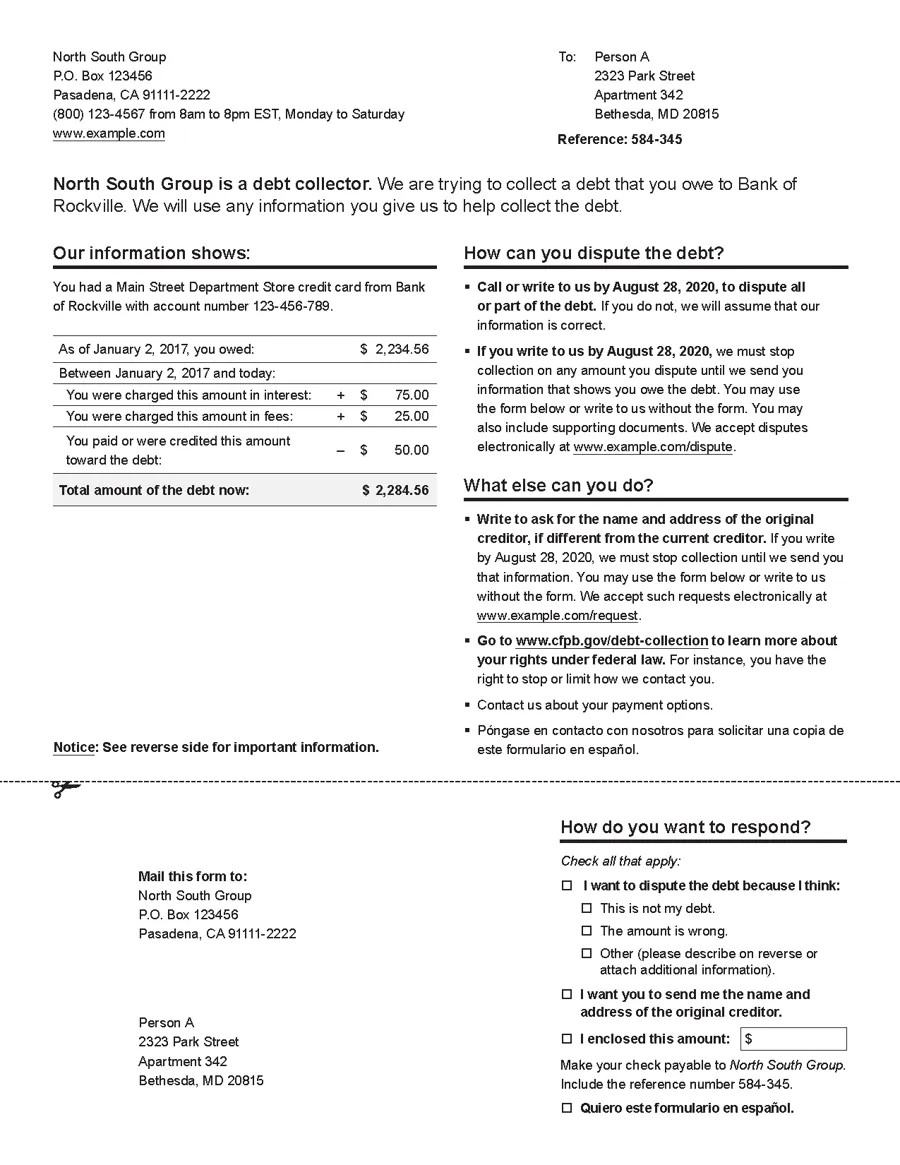
A collector must send you a validation notice. It lists the debt details and the end date of your 30-day dispute period. Find that date first.
Send a written dispute before the end date. Then the collector must stop collecting the part you dispute until it mails you proof. Our validation letter tool helps you write that letter.
30 days
You have 30 days to dispute in writing.
So the end date printed on the collector's notice is the date that matters, not the day you opened it.
Example: if the notice says November 14, send it certified mail no later than November 7. A week early leaves time for it to arrive. Keep the receipt.
5 days
A collector must send the written notice within five days of first contact.
So a collector that calls but sends nothing in writing within five days is a warning sign.
Ask for the validation notice and do not pay until you have it.
$1,000
A court can award up to $1,000 in extra damages.
So a collector that breaks the rules can end up paying you.
Keep every letter and log every call before you talk to a consumer lawyer.
The five days and the 30 days come from the CFPB. The $1,000 comes from the FTC.
What can't a debt collector do?
A collector cannot call you before 8 a.m. or after 9 p.m. your time unless you agree. More than seven calls in seven days about one debt is presumed unlawful.
A collector cannot threaten you or lie about what you owe. It cannot tell your boss, family, or neighbors about your debt. It can talk with your spouse or your lawyer.
If you prove a collector broke these rules, a court can award up to $1,000 in extra damages. The money is not automatic. Log the calls with our call log checklist.
The call hours and the seven calls rule are in the CFPB call rules.
Do you live in New York City?
If you live in New York City, the SHIELD rule took effect on September 1, 2026. Collectors get three attempts within seven days to reach you, and you can dispute a debt at any point. The rule is from NYC Consumer and Worker Protection.
What do I do in the next 30 days?
- Day 1: Write down the collector's name, the number that called, and the date.
- Before the end date on the notice: Mail your dispute letter by certified mail and keep the receipt.
- Same week: Look up the time limit to sue on a debt in your state.
- If court papers come: File your answer by the date on the papers. Read what to do if you are sued, or call our debt help line during business hours before your answer date.
Got court papers in your state? Call before your answer date. Call (844) 393-5856
Example: Odell gets a notice naming Midland and a bank he knows. Knowing the bank does not prove the amount is right. He finds the end date on the notice and mails his dispute letter before that date. He keeps the certified mail receipt as proof.
Which collectors can I look up?
The counts in this table are federal complaints filed since October 2023. They come from the Consumer Complaint Database. A complaint is not a ruling that the company broke the law. Some totals cover a parent company, so do not add related rows together.
| Collector | Kind | Complaints |
|---|---|---|
| CBE Group | collection agency | 2,461 |
| Credit Collection Services | collection agency | No CFPB rows under this name |
| Enhanced Recovery Company | collection agency | No CFPB rows under this name |
| Hunter Warfield | collection agency | No CFPB rows under this name |
| IC System | collection agency | 15,337 |
| Jefferson Capital Systems | debt buyer | No CFPB rows under this name |
| LVNV Funding | debt buyer | 56,568 |
| Mandarich Law Group | collection law firm | 296 |
| Midland Credit Management | debt buyer | 45,412 |
| National Credit Systems | collection agency | 15,027 |
| Penn Credit | collection agency | 1,167 |
| Portfolio Recovery Associates | debt buyer | 41,649 |
| Radius Global Solutions | collection agency | 6,176 |
| Rausch Sturm | collection law firm | 445 |
| Resurgent Capital Services | servicer for debt buyers | 56,568 |
| Revco Solutions | collection agency | 549 |
| Transworld Systems | collection agency | 12,561 |
| Velocity Investments | debt buyer | 2,113 |
| Weltman Weinberg and Reis | collection law firm | 356 |
| Zwicker and Associates | collection law firm | 540 |
The counts come from the CFPB complaint database.
What does this letter say?
Paste the text of the collector's letter. You get back who sent it, the amount and dates it states, and your choices. Press Explain to send your text to our AI provider, which writes the explanation. We record that an explanation ran. We do not keep your text. Take out your address and full account number first.
You have a collector's letter about a debt in your state. A consumer lawyer can go over those dates with you before the end date passes. Call with the letter in hand, and you decide whether a lawyer sees it.
Call (844) 393-5856Calls go to our debt help line during business hours. The call costs you nothing, and you give up nothing by calling. Debt Collector Lookup matches people with consumer lawyers; we are not a law firm or a debt collector.
Which letter or tool do you need?
- Write a validation letterFill it in, print it, and count the days to your end date.
- Answer a lawsuitFind your answer date and what to file.
- Stop the callsLog the calls and see what the law bans.
- Check the time limitYears to sue, by state and kind of debt.
- Price a settlementSee what an offer costs before you send it.
- Ask for deletionBuild a pay for delete letter.
Questions people ask
How do I find out who my debt collector is?
Look at the first letter you got. It names the collector and the creditor you first owed. Type the collector's name in the search box to see its company card.
How do I check that a debt collector is real?
Ask for the company name, street address, and phone number. Then hang up and call back on a number from the company's own website. A real collector also sends you the debt details in writing.
What is the seven calls in seven days rule?
Federal rules presume a collector broke the law if it calls more than seven times in seven days about one debt. The same goes for a call within seven days after you talked about that debt. Keep a dated log of every call.
Can I look up collections on my credit report?
Yes. Your credit reports list each collection account and the collector's name. Match that name to our collector list.
Do I have to pay a debt collector?
You only owe it if the debt is yours and the amount is right. Ask for proof first with a validation letter. If the debt is past the time limit to sue in your state, a collector cannot sue or threaten to sue you over it.
What happens if I ignore a debt collector?
The calls and letters keep coming. The collector can sue you, and if you miss the court date, the judge can rule against you. That ruling can let them take money from your pay or your bank account.
Sources
- CFPB: what the notice must show (consumerfinance.gov).
- CFPB: what counts as harassment (consumerfinance.gov).
- CFPB: when a collector can call (consumerfinance.gov).
- FTC: fake and abusive collectors (consumer.ftc.gov).
- FTC: debt collection FAQs (consumer.ftc.gov).
- CFPB: complaint database (consumerfinance.gov).
- CFPB: model validation notice (consumerfinance.gov).
- NYC Consumer and Worker Protection: the SHIELD rule (nyc.gov).
Last checked October 2026.
What to do now
You have a collector's letter or court papers about a debt in your state. A consumer lawyer can review the amount and your dates before those dates pass. Send the collector's name and what it wants below, or call during business hours to talk it through first.
Sending this costs nothing and commits you to nothing. We keep your answers with the collector's name, and you decide whether a consumer lawyer sees them. Debt Collector Lookup is not a law firm or a debt collector. The form does not schedule a call; to talk, call our debt help line during business hours.